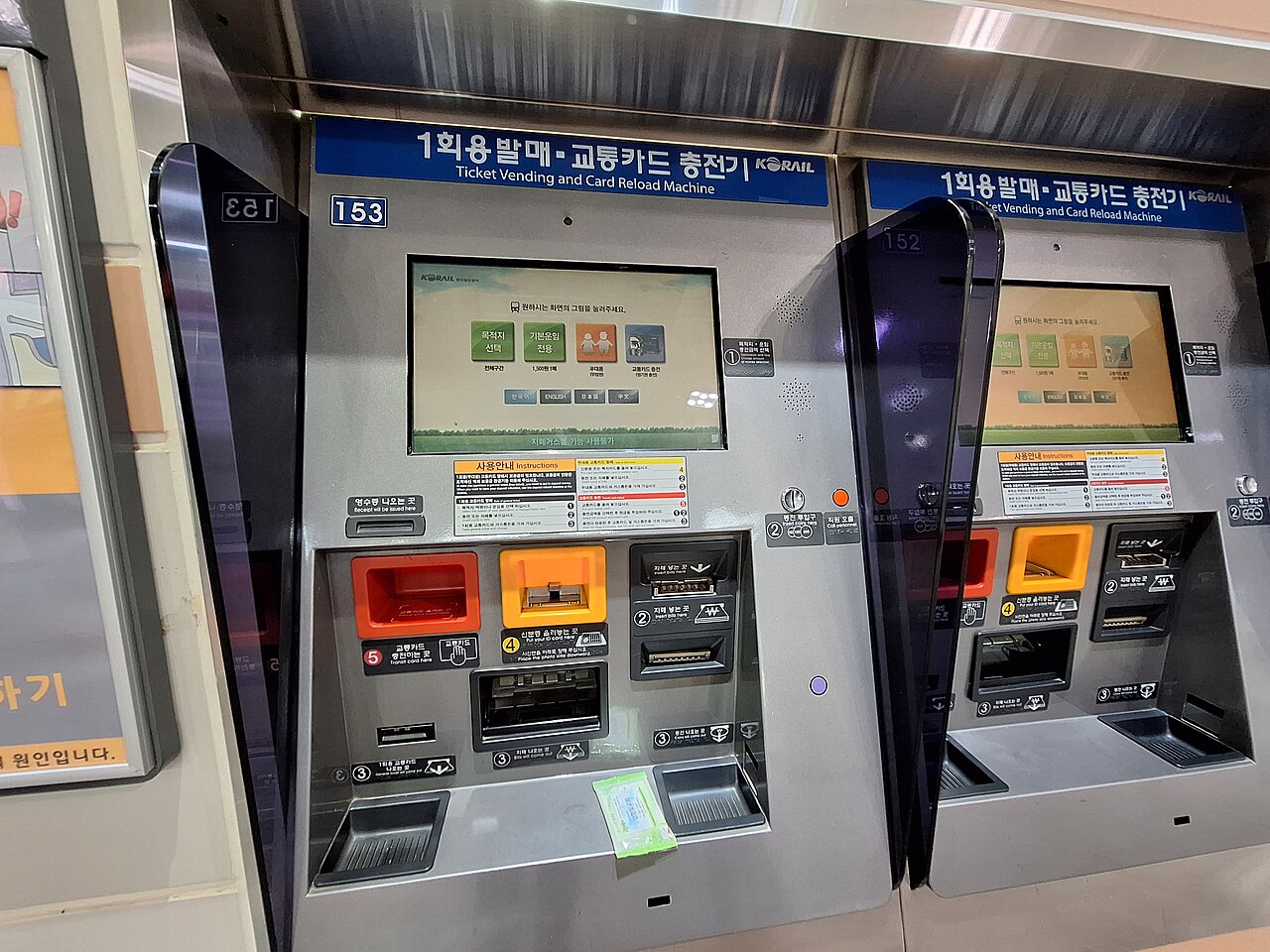
Ticket Vending and Card Reload Machine - Seoul Metropolitan Subway 20240713.jpg · LandAndTree · CC BY 4.0 · Image details
Choose by how you will travel and pay
For a straightforward first visit, a physical Tmoney card plus Korean-won cash for top-ups is a practical default. Consider a short-term Climate Card if you expect repeated journeys inside its coverage. Choose WOWPASS if you also want its prepaid shopping-payment functions and are willing to manage a separate transport balance.
A report that “foreign cards work now” needs a second question: where, for which product, and through which app or machine? It does not mean a foreign bank card can simply replace your transport card at every gate.
October 2026 coverage change: the short-term Climate Card continues, but its subway coverage changed on October 1. Do not use an older map of the Gyeonggi extensions. The current rules and the airport exception are explained below.
Compare the purchase and reload routes
| Product | Where to get it | How to fund transport use |
|---|---|---|
| Ordinary physical Tmoney | Participating convenience stores and station outlets | Bring won cash for standard convenience-store or station-machine top-ups. |
| Short-term Climate Card | Eligible station vending machines; participating outlets sell physical cards | Load a pass at a charging machine. Overseas cards are supported at the new machines covered by Seoul’s rollout. |
| WOWPASS | WOWPASS kiosks; locate one using the app | Its Tmoney balance needs a separate top-up from its shopping balance. |
| MobileTmoney on iPhone | Tmoney’s official app | The app has a traveler funding route; direct Wallet funding has different conditions. |
The Korea Tourism Organization’s payment matrix specifically distinguishes cash-funded ordinary Tmoney from foreign-card-supported Climate Card and single-journey ticket machines. Use that distinction when choosing a queue or asking a cashier for help.
Buying and loading physical Tmoney
Tmoney is sold through convenience stores such as CU, GS25 and 7-ELEVEN; participating subway outlets also sell cards. Card designs and prices vary. KTO’s retail guide
At a convenience store:
- Ask for a Tmoney card.
- Pay for the physical card.
- Separately request a top-up and give the cashier won cash.
- Confirm the amount loaded before leaving.
Buying the plastic and loading travel money are separate transactions. For example, if you choose to load KRW 10,000, that is your chosen travel balance, not a promise that the card itself is included for that amount.
A useful phrase is “티머니 충전해 주세요” — “Please top up my Tmoney.” Show the intended amount on your phone if necessary. At a station machine, choose its transport-card recharge function, place the card where instructed, and leave it there until the process finishes.
The current tourist products also have specific names. Tmoney lists TMONEY TRAVEL CARD at KRW 4,000 and TMONEY TRAVEL CARD+ at KRW 6,000. The latter adds WOWPASS payment functions. The older KOREA TOUR CARD is no longer sold, according to Tmoney’s own product page. Product prices were rechecked October 11, 2026.
Climate Card: use the right machine and pass
Seoul’s dated announcement introduced overseas credit/debit card payment on 17 March 2026 at new transport-card vending machines in its specified Lines 1–8 station network. It covers physical Climate Card purchase, short-term pass loading, and single-journey tickets. It is not an announcement of ordinary Tmoney foreign-card top-ups.
At a participating machine, select English, choose the Climate Card transaction, select your short-term duration, and review the total before paying. Seoul reported an average 3.7% service fee for overseas-card transactions; use the amount displayed for your actual purchase. March 2026 announcement
A physical Climate Card costs KRW 3,000 separately from the pass. Published short-term prices are:
| Duration | Pass price |
|---|---|
| 1 day | KRW 5,000 |
| 2 days | KRW 8,000 |
| 3 days | KRW 10,000 |
| 5 days | KRW 15,000 |
| 7 days | KRW 20,000 |
A short-term pass starts on its loading date; a one-day pass is not a rolling 24-hour product. Short-term passes do not include Ttareungi bike rental or the Hangang Bus. Seoul’s current short-term product information, checked October 11, confirms the prices and conditions above.
Check the October 1 service area before buying
The current Seoul short-term FAQ, question 95, says coverage is Seoul-area subway travel and Seoul-licensed city/town buses, including night buses. Previous subway extensions into Gimpo, Goyang, Gwacheon, Guri, Seongnam, Hanam and Namyangju are excluded from October 1, 2026. Seoul-licensed eligible buses can still be used outside Seoul; the bus operator’s licensing area matters.
Airport buses, the Sinbundang Line and GTX are excluded. The AREX All-Stop exception still permits getting off at Incheon Airport T1 or T2 after boarding within the covered area; it does not permit boarding at either terminal. AREX Express requires its own ticket. For an out-of-range subway destination, the city says the fare from the boarding station is charged separately, not merely the uncovered final section. Current service rules
Use the station coverage search for both ends of your journey. The English policy page still displays older extensions, so the October 1 Korean operating page is the reference for this update. Incheon Airport and Gimpo Airport Station are also different places from Gimpo city; check the named station rather than inferring coverage from the word “Gimpo.”
The 30-day product has ended; tourist short-term passes continue. Resident-oriented Climate Pass benefits should not be substituted for these tourist-pass rules.
Work out whether a pass fits your actual days
Write your intended paid journeys beside each sightseeing day. A bus–subway connection may be one discounted journey; counting every vehicle as a separate full fare can make a pass look artificially attractive. Exclude airport buses, intercity trains and any other uncovered legs from the savings calculation.
For an illustration, consider three consecutive days of covered Seoul travel. Seoul lists an adult subway card base fare of KRW 1,550; longer trips can cost more. City fare table
| Invented travel pattern | Pay-as-you-go travel cost | Three-day Climate pass |
|---|---|---|
| Two separate base-fare subway journeys each day: 6 total | KRW 9,300 | KRW 10,000 |
| Four separate base-fare subway journeys each day: 12 total | KRW 18,600 | KRW 10,000 |
These are cost examples, not fares for named routes. They exclude buying either physical card, payment fees, distance charges and uncovered journeys. Add KRW 3,000 if buying a Climate Card; add the actual card price if you also need a new pay-as-you-go card. If you already own Tmoney, its original purchase cost is not a new trip expense. Compare the resulting totals before paying.
Loading-day example: you reach Seoul on Monday evening but will use most transit on Tuesday, Wednesday and Thursday. Loading a three-day pass on Monday uses Monday as day one and ends with Wednesday’s service. Loading on Tuesday covers Tuesday through Thursday; pay separately for Monday’s arrival if that is the better total. The pass cannot be loaded today with a future start date. Seoul’s short-term FAQ, question 98
Apply the comparison to the area blocks in our Seoul five-day plan. A mostly walkable day around one neighborhood may need fewer paid journeys than a day crossing the city. Buy for the routes you want, rather than adding unnecessary rides to justify the pass.
WOWPASS: two balances, one physical card
WOWPASS can make sense when you want prepaid shopping payments as well as transit. The operator advertises cash funding at its kiosks and mobile funding with supported international cards or e-wallets. WOWPASS funding information
However, a positive WOWPASS shopping balance does not prove you have money available for the next subway ride. Its official guide says the integrated Tmoney balance must be topped up separately.
To fund the transport balance using the WOWPASS app:
- Open its Tmoney top-up function with the physical WOWPASS card ready.
- Follow the app’s NFC card-scanning and amount-selection prompts to move your chosen amount from the WOWPASS balance. Keep the card in place as instructed until the top-up finishes.
- Confirm that the Tmoney transport balance has increased before joining the boarding queue.
This is a separate operation from adding money to the shopping wallet. If your phone cannot complete it, won-cash top-ups at subway stations and participating convenience stores remain an alternative. Do not repeatedly add money to the shopping wallet to resolve an insufficient-transport-balance message. WOWPASS’s Tmoney top-up instructions — checked 12 September 2026. These are the operator’s instructions, not a payment or device test by this site.
iPhone Tmoney: distinguish the app from Wallet
Tmoney’s current iPhone app listing describes traveler setup without sign-up and in-app Apple Pay top-ups. Its release notes name Mastercard, American Express, UnionPay and JCB. Do not assume Visa is supported because another card brand works.
Apple’s separate Wallet instructions say direct Tmoney purchase or top-up from Wallet requires a South Korea-issued card. These are different funding paths, so follow the official Tmoney app route if using its traveler feature.
Complete setup before relying on it at a gate, and keep a cash/card fallback if your issuer declines. This guide has not tested an individual foreign-issued card or completed an app payment.
Whichever product you choose, learn the actual bus tapping sequence and subway transfer process. Funding a card is only the first step.
October 11 review: current Climate Card coverage and prices, machine-payment guidance, Tmoney product prices, WOWPASS’s separate balances and the iPhone funding distinction were checked against official sources. Detailed WOWPASS NFC steps retain the September 12 check; follow the current app prompts. The cost and loading-day examples are planning illustrations, not payment tests.
Sources & further checks
- Korea Tourism Organization: visitor transport payment matrix
- Korea Tourism Organization: transport card retail locations
- Tmoney: current travel-card products
- Seoul: foreign-card payments at new station machines, March 2026
- Seoul: Climate Card short-term passes and discontinuation notice
- Seoul: short-term Climate Card rules from October 1, 2026 (Korean)
- Seoul: short-term Climate Card FAQ, including changed coverage (Korean)
- Seoul: current Climate Card station coverage search
- Seoul: adult subway base fare
- WOWPASS: official use and separate Tmoney balance
- WOWPASS: app and kiosk funding methods
- Tmoney developer: MobileTmoney app requirements and release notes
- Apple: adding and topping up transit cards in Wallet
Official-source research does not imply that we visited the location or completed a purchase. Read our research approach.
General travel information, not financial, legal or immigration advice. Prices, rules and availability may change.