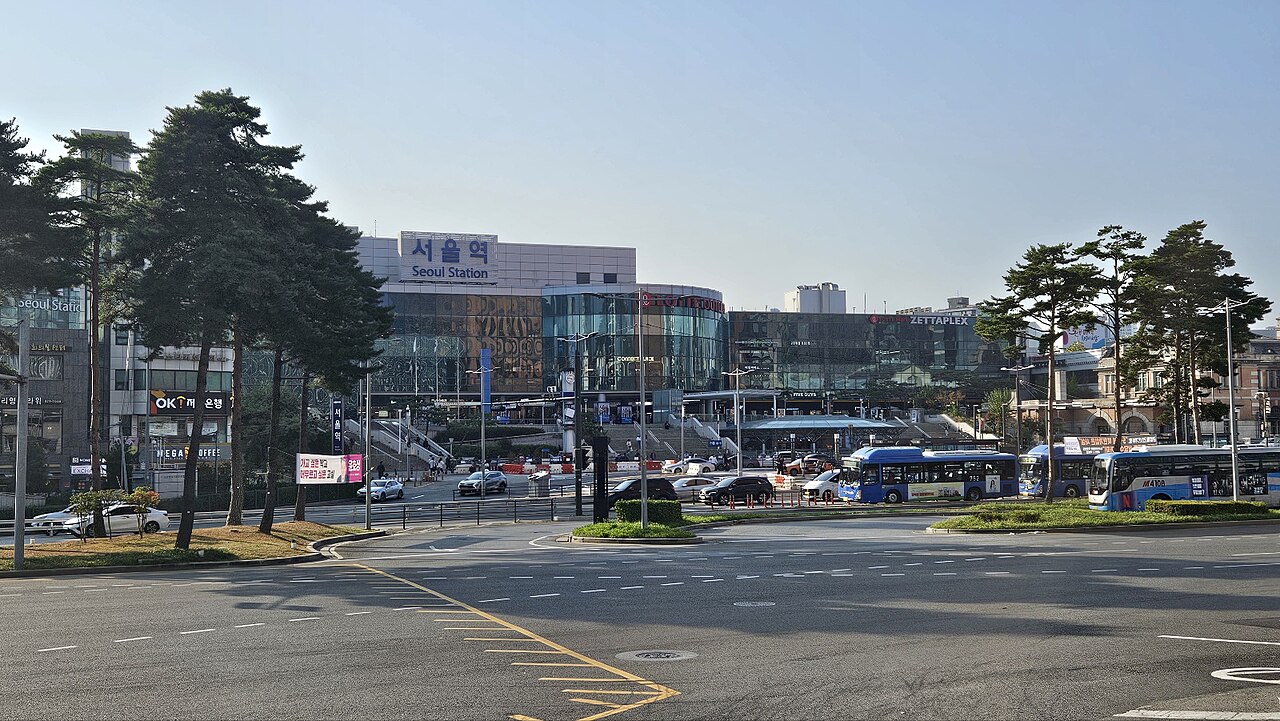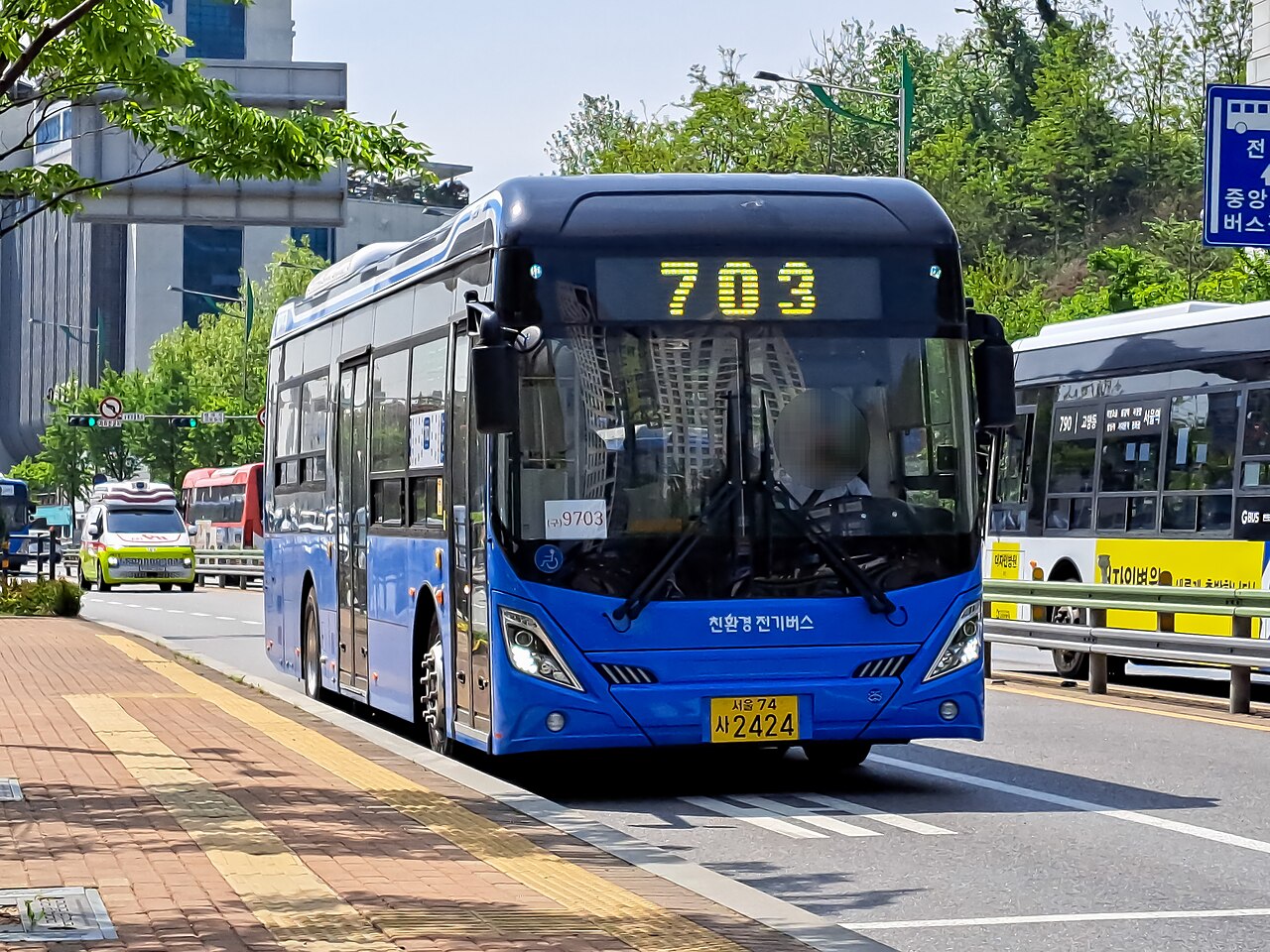
Seoul bus 703 CRRC.jpg · Wikiwater2020 · CC BY-SA 3.0 · Image details
The short version
For an ordinary Seoul city-bus journey, board at the front, tap your funded transport card, press the stop button before your stop, and tap again as you leave through the rear door. Use the same card throughout the trip. Keep a takeaway iced coffee off the bus: a disposable cup containing a drink or ice can be refused even if you intend only to carry it.
This guide covers Seoul city buses. An airport limousine, reserved intercity coach, or bus in another city may have different boarding and payment arrangements.
Verification scope: overnight buses and transfer rules were rechecked on September 10, 2026. The boarding and food guidance retains its September 6 source check.
1. Find the stop going in your direction
In your map app, open the full journey rather than memorizing only the bus number. Note the boarding stop, the stop where you leave, and the direction or next stop shown for the bus.
Opposite sides of a road can serve opposite directions under similar stop names. Compare the app’s boarding location with the physical stop and the listed route. If you are standing beside the wrong stop, cross using a pedestrian crossing; do not assume a bus with the correct number is heading your way.
Our NAVER Map setup guide explains how to turn a search result into a usable route. NAVER documents location-based transit guidance and boarding/alighting reminders, but an app alert is a backup to reading the bus and stop information. NAVER’s guidance description
Before the bus arrives, put your card within reach and finish any drink that cannot travel in a sealed container. Doing both at the stop avoids discovering a problem while others are boarding behind you.
2. Board, tap, and move clear
The normal sequence is:
- Wait for the bus to stop and the front door to open.
- Present your transport card to the reader beside the driver.
- Wait for the reader’s response before walking past it.
- Move away from the doorway and hold a rail or sit down.
You do not normally buy a destination-specific ticket for a standard city-bus ride. If the reader rejects the card, pause and ask the driver rather than repeatedly switching cards. Have a short message ready: “카드가 안 돼요” — “My card isn’t working.”
These boarding arrangements come from Seoul’s official passenger instructions. Using your bank card to buy something in a shop does not establish that it functions as a Korean transport card.
3. Request your stop, then tap out
As your destination approaches, press the stop button in time for the driver to stop safely. The button requests a stop; tapping your card does a different job.
Keep hold of a rail while preparing to leave. At the rear-door reader, tap the same card you used to board, wait for the response, and leave when the bus has stopped and the door is open. Do not copy another passenger’s apparent failure to tap: you may not have seen what they did.
For an eligible connection, board within 30 minutes after tapping out, or 60 minutes when the next boarding is from 21:00 to before 07:00. Missing the exit tap can break the discount. Seoul’s transfer instructions See our transfer examples, including the 07:00 boundary.
Seoul night buses after the last train
Seoul’s Owl buses (올빼미버스) run overnight on designated city routes such as N26. Seoul lists 14 routes and an overall operating period of 23:00–06:00; individual routes have different first and last departures. This is not a promise of service at every stop throughout those hours. Seoul’s owl-bus overview
The published adult transport-card fare is ₩2,500. Tap when boarding and leaving. A transfer can still involve a higher base fare or a distance charge; do not budget on every connection costing zero. Seoul’s fare table and transfer explanation
Find the actual stop, direction and next arrival
Start with a public-transport route in your map app for the time you intend to leave. Then use Seoul TOPIS bus search to inspect a proposed N route:
- Enter the full route number, for example N26, in the search field and submit it.
- Choose 버스 (Bus) in the results, then open the route number.
- Select the direction ending in 방면 (toward). Match your boarding stop’s name and stop number; the other side of the road may serve a different direction.
- Select that stop to see arriving buses. 분 means minutes, 출발대기 means awaiting departure, and 운행종료 means service has ended. Refresh close to departure; a saved screenshot is not a live arrival estimate.
For example, the N26 route checked on September 10 lists Hongik University Station / 홍대입구역 (14015) before Gwanghwamun Station / 광화문역 (01009) in the 중랑공영차고지 방면 direction. This gives you a concrete route to inspect for a Hongdae-to-Gwanghwamun trip; check the current stop and arrival before walking there. TOPIS route and stop lookup
Route first/last times are different from your stop’s arrival time. A bus departing its terminal or depot still has to reach the intermediate stops. Use the stop’s live arrival information rather than treating the route’s 첫차 / 막차 fields as a timetable for your boarding point. Some owl routes list 30–40-minute gaps, so include the walk and wait when comparing the bus with a taxi. Official route intervals
Airport night buses are a separate service
An N prefix alone is not enough: Incheon Airport’s overnight coaches, including N6000, have their own fares, ticket arrangements and terminal-specific departures. The ₩2,500 Seoul owl-bus fare is not an airport-coach fare. Check your arrival terminal in Incheon Airport’s late-night bus guide, then plan the final trip from the coach stop to your accommodation.
Coffee and food: what can you bring?
A takeaway cup with iced coffee or remaining ice is a poor boarding choice. Seoul permits city-bus drivers to refuse spill-prone food or drinks. A standard takeaway lid is not listed as an exception. The safety ordinance still includes the disposable-cup provision in its January 2025 version. Article 11(6)
| What you are carrying | Seoul’s published examples |
|---|---|
| Disposable cup containing coffee, another drink, or ice | Restricted; boarding can be refused. |
| Closed plastic drink bottle | Allowed as a sealed-container example. |
| Properly sealed tumbler or thermos | Allowed as a sealed-container example. |
| Unopened drink can | Allowed. |
| Packaged pizza or chicken being taken elsewhere | Allowed as packaged food for transport. |
These examples are from Seoul’s detailed food rules. Permission to carry sealed food is not permission to eat it on the bus. The Korean explanation explicitly separates transport from consumption.
The practical solution is to finish and dispose of your drink appropriately before boarding, or use a genuinely sealable container. Do not put a leaking cup in a bag and treat that as an exemption. The published examples do not settle every empty-cup situation, so we do not promise that an empty takeaway cup will always be accepted.
This is a Seoul city-bus rule, not evidence that identical restrictions apply to every Korean train, subway, or airport bus.
If something goes differently
The next bus displays a zero fare: that can be consistent with a transfer. It does not mean all later travel is free. Continue to tap out; distance or a higher applicable fare may still affect the total.
You missed your stop: remain on board until the next safe stop, then recalculate from your actual location. Do not assume a return ride on the same bus number receives a transfer discount.
You forgot to tap out: do not try to fix it by presenting another card. For a disputed charge, retain the card and record the bus number, boarding and exit stops, and approximate time.
For the next part of your journey, read Seoul subway transfers and fare examples.
Sources & further checks
- Seoul: public transportation boarding and alighting instructions
- Seoul: integrated transfer rules, updated February 2026
- Seoul: owl-bus routes and operating overview, updated March 2026
- Seoul: transport modes and adult owl-bus fare
- Seoul TOPIS: bus route and stop search
- Incheon Airport: Terminal 1 late-night buses to Seoul
- Seoul: specified food and drink restrictions for city buses
- Seoul: Korean explanation of sealed-container exceptions
- Seoul city-bus safety ordinance, Article 11(6), effective January 2025
- NAVER: public transport guidance
Official-source research does not imply that we visited the location or completed a purchase. Read our research approach.
General travel information, not financial, legal or immigration advice. Prices, rules and availability may change.