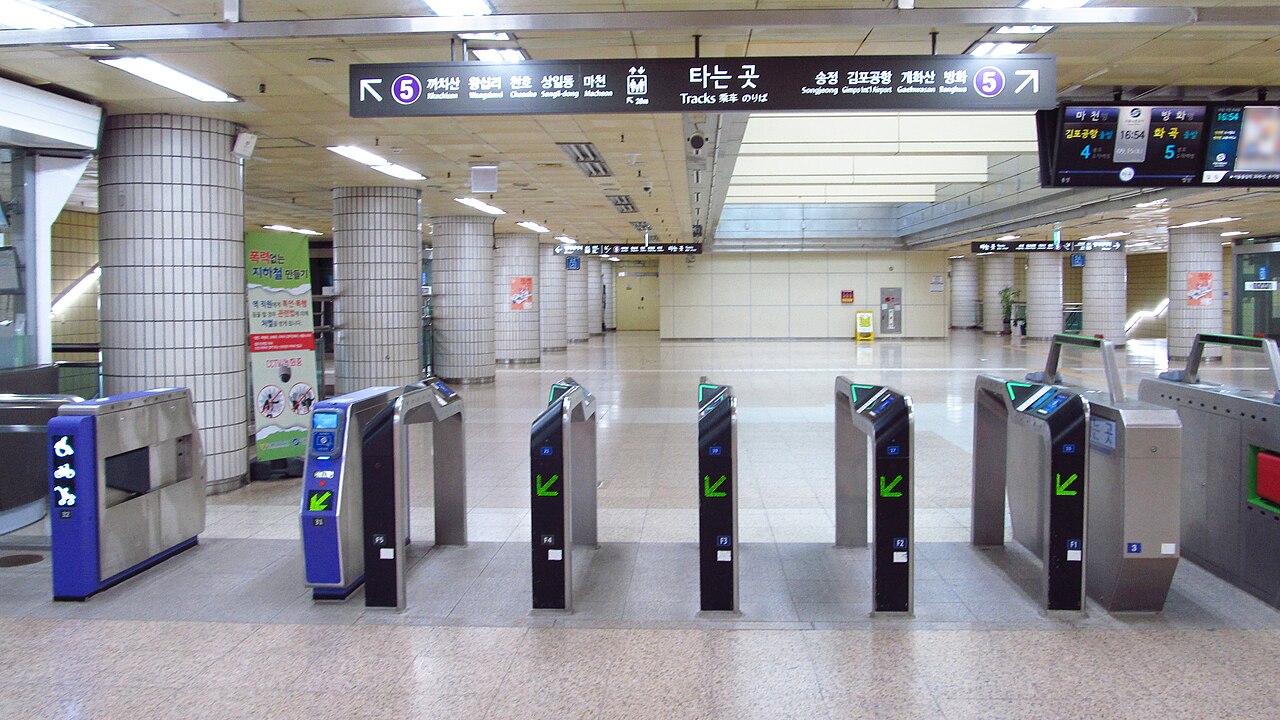
Seoul-metro-514-Magok-station-gate-20180915-165610.jpg · LERK · CC BY-SA 4.0 · Image details
Follow the line, direction, and destination
To ride the Seoul subway, enter with a valid ticket or funded transport card, find the correct line and direction, follow transfer signs when changing lines, and use the same card to exit at your destination. A numbered street exit is different from a platform or transfer passage.
Verification scope: the 15-minute re-entry section was checked on October 18, 2026. The bus–subway transfer limits and examples retain their September 10 check, and station navigation retains its September 6 check.
For an ordinary connection inside a station, follow signs to the next line rather than leaving through a street-exit gate. Some connections have readers along the transfer route: follow the marked passage and the instructions at those readers.
Visit Seoul’s passenger guide describes station signs, ticketing, and exit-card use. The instructions below turn that into a journey you can prepare before walking through the gates.
1. Prepare a route you can read at a glance
Open your destination in NAVER Map and select a public transport route. Write down these five pieces of information:
| Route detail | Why you need it |
|---|---|
| Boarding station and line | Large stations can contain several different lines. |
| Direction or next station | The right line can still take you the wrong way. |
| Interchange station and next line | This tells you which transfer signs to follow. |
| Final station | You leave the train here, before starting the street walk. |
| Recommended street exit | The nearest-looking exit may be on the wrong side of a large road. |
Keep the destination’s Korean name and address as well. If your hotel has several branches, the full address is more reliable than recognizing a brand name.
For a practice exercise, choose any route in the app and describe it aloud: “Start at this station, take this line toward this next station, change here, and leave through this exit.” If you cannot identify one of those steps, inspect that part of the route before entering.
2. Enter the gates and choose your platform
Use one ticket or transport card per traveler. Hold it to the entry reader and wait for approval before walking through. Keep that card available for the exit.
Inside, match the line number or name, then the direction shown on station signs. A direction label may name a station beyond your destination. Compare the next station with your route rather than expecting the display to show the place you are visiting.
On a platform served by different stopping patterns or branches, inspect the arriving train’s destination and stop information. Do not assume every train sharing a line color stops at every station you need.
If the gate rejects a valid-looking card, use the help point or ask station staff. Do not follow another traveler through or try to squeeze around the gate.
3. Change lines without taking an accidental street exit
At your interchange:
- Step off the train and move clear of the doorway.
- Find the sign for the line you need next.
- Follow its arrows through the station.
- Recheck direction at the next platform.
- Board only after confirming the arriving service matches your route.
A street exit number helps you leave the station. It does not tell you which train to board. If you see an exit gate earlier than expected, stop and compare the signs with your route; ask staff if the transfer passage is unclear.
A longer walk between platforms can be part of a normal interchange. Allow time for that walk, especially with luggage. Seoul’s official visitor app also documents station-direction guidance, including exits and facilities. Seoul Subway app information
4. Exit, then follow the final walking route
At your destination, tap the card used at entry and wait for the reader to approve your exit. Follow the numbered exit in your walking directions. If you need a lift, prioritize the signed accessible route even if it reaches the street somewhere different; then recalculate the final walk.
Before leaving the station, confirm the map’s destination is the actual entrance you need. A museum boundary, apartment complex, or shopping center can occupy much more space than its single map pin suggests.
Bus–subway transfer time limits
Measure the gap from your exit tap to the next boarding tap. The next boarding time determines which limit applies, even if the previous ride ended before the clock crossed 07:00 or 21:00.
| Next boarding time, Korea time | Maximum gap after the previous exit tap |
|---|---|
| 07:00 to before 21:00 | 30 minutes |
| 21:00 to before 07:00 the next morning | 60 minutes |
This is the time to make the connection, not a requirement to finish the whole journey within 30 or 60 minutes. Seoul’s operational rules explicitly use the next boarding time.
These invented examples illustrate eligible bus–bus or bus–subway connections, assuming the other conditions are met. They are not service timetables:
| Exit tap → next boarding | Result |
|---|---|
| 14:00 → 14:20 | 20-minute gap: within 30 minutes. |
| 14:00 → 14:40 | 40-minute gap: outside 30 minutes. |
| 21:10 → 21:50 | 40-minute gap: within the nighttime 60 minutes. |
| 06:20 → 06:55 | 35-minute gap: within 60 minutes. |
| 06:20 → 07:05 | 45-minute gap: outside the now-applicable 30 minutes. |
Time alone does not make a transfer eligible
Use one transport card per person, keeping that same card for the linked journey. Tap at every required entry and exit; a missed bus exit tap can end the fare connection and cause additional charges. Seoul’s card and exit-tap conditions
The limit is four transfers, meaning five boardings. Reboarding the same bus route or the same vehicle does not qualify, even within the time window. If you overshoot and return on the same route, expect a new fare. Seoul’s transfer limits and exclusions
A transfer discount does not promise a zero-cost journey. The system accounts for the applicable base fare and distance; an additional amount can appear later. Seoul’s fare explanation
These are capital-area conditions, not a nationwide rule. For comparison, Busan’s operator describes two transfers within its local system. Our bus boarding guide covers the physical tapping sequence.
The longer nighttime window does not mean the subway runs all night. If your last train has gone, check Seoul’s N-bus routes and stop arrivals before relying on a bus connection. A timetable gap can outlast the discount window.
Wrong platform or accidental exit?
If you are still inside the paid area, look for the signed route to the other platform or ask staff before exiting. If you have already tapped out, note the time and the line shown at that gate before choosing where to tap in again.
Check the station, line, card and clock
On participating sections, use the same transport card at the same station and the same line’s gates within 15 minutes of the exit tap. The benefit applies once during a subway journey and uses one transfer allowance. It avoids another base fare; it does not remove any applicable distance charge. This separate re-entry rule does not become 30 or 60 minutes at night. Seoul’s card and fare conditions, with the later extension to 15 minutes; June 2026 KORAIL extension
| Situation after tapping out | What to do |
|---|---|
| You need to correct direction or briefly leave for a toilet | Check that the section participates, then return through the same line’s gates within 15 minutes using the same card. |
| Another line has gates in the same station complex | Do not treat the shared station name as enough. Ask staff for the correct route before tapping. |
| More than 15 minutes have passed, or you already used re-entry on this journey | Expect a new base fare; ask staff if a gate or card error caused the problem. |
| You have a single-journey ticket, a pass, or an unclear card error | Use the gate help point. The KORAIL notice directs single-ticket and season-pass users to staff assistance through the emergency gate; do not open or follow someone through it yourself. |
Coverage extends beyond the older Seoul-only list
Seoul’s published list, marked with an October 7, 2023 reference date, includes Lines 2, 5, 8 and 9, Ui–Sinseol and Sillim, plus specified sections of Lines 1, 3, 4, 6 and 7. It is not the complete current metropolitan coverage map. From June 20, 2026, the ministry extended re-entry to KORAIL-operated metropolitan sections of Lines 1, 3 and 4, plus Suin–Bundang, Gyeongui–Jungang, Gyeonggang and Seohae. Ministry announcement
It is still not a network-wide promise: the ministry lists exclusions including AREX, Sinbundang, Gimpo Goldline, Uijeongbu and Yongin light rail, Incheon Lines 1–2, and Line 7’s Kkachiul–Seoknam section. At an excluded or uncertain gate, ask staff before relying on free re-entry.
Planning example: an exit tap at 14:00 and return at 14:12 can qualify if the card, same-station/same-line, coverage and once-per-journey conditions are met. Returning at 14:16 misses this allowance even though it is inside the bus–subway 30-minute window. Do not rush unsafely to beat the clock.
Show staff your card and destination, and say “방금 잘못 나왔어요. 다시 들어가려면 어떻게 하나요?” — “I just exited by mistake. How can I get back in?” Keep the explanation specific instead of repeatedly tapping at different lines’ gates. These are official-source instructions and planning examples, not a tested gate transaction.
Sources & further checks
- Visit Seoul: using the subway
- Seoul: transport modes and integrated fares
- Seoul: integrated transfer rules, updated February 2026
- Seoul: 15-minute re-entry policy and scope
- Seoul: original re-entry conditions (time limit later extended to 15 minutes)
- Ministry of Land, Infrastructure and Transport: KORAIL 15-minute re-entry extension, June 2026
- Seoul: subway app and station guidance for visitors
- Busan Transportation Corporation: local transfer conditions
Official-source research does not imply that we visited the location or completed a purchase. Read our research approach.
General travel information, not financial, legal or immigration advice. Prices, rules and availability may change.