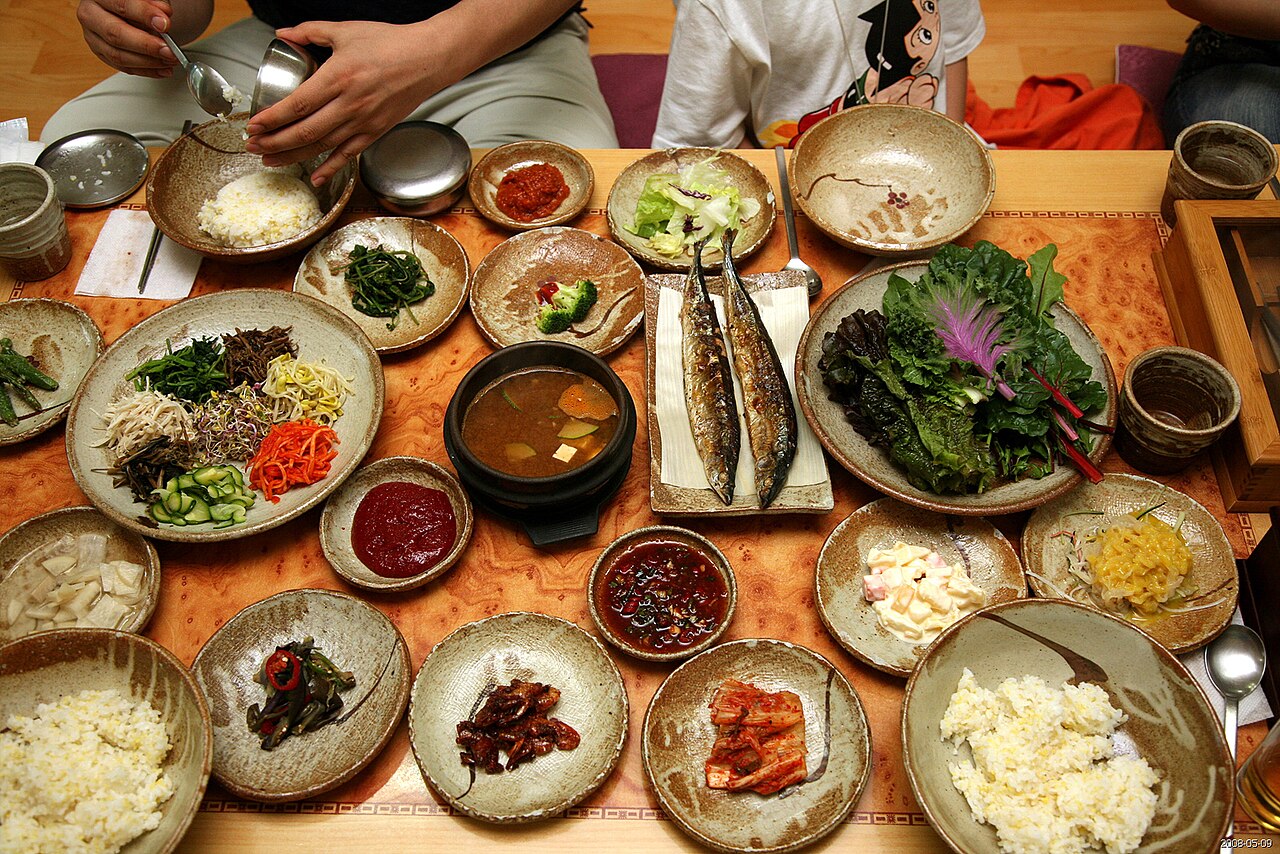
Korean food-Bibim ssambap and various banchan-01.jpg · Jinho Jung · CC BY-SA 3.0 · Image details
Check three things before confirming your order
Check the minimum quantity, where to order, and when to pay. Those answers matter more than memorizing one restaurant routine for all of Korea.
A price beside a dish may not be the final amount for your party. Sending an order from a screen may not mean that payment is complete. Water or utensils may be waiting at a self-service area. Use the restaurant’s menu and signs to resolve these details before adding more food or making another payment.
Read the portion and minimum separately
The Korea Tourism Organization’s restaurant-sign translation guide includes examples of one menu item per customer, minimum quantities, and dishes that start at two servings. These are different conditions, not a national rule requiring everyone to dine in pairs.
1인분 means one serving. 2인분부터 means orders start at two servings. 1인 1메뉴 asks each person to order a menu item. Confirm which condition applies to the dish you want.
For a hypothetical example, imagine a menu showing KRW 12,000 per serving with a two-serving minimum. Ordering that dish starts at KRW 24,000 before any separately priced extras. The example is arithmetic, not a current restaurant price.
If you are alone, ask two separate questions: can the restaurant seat one diner, and can you order one serving of this dish? Offering to purchase two servings does not guarantee that a restaurant will seat you. If its arrangement does not suit your appetite or budget, choose another dish or place before ordering.
Find the ordering method
VISITKOREA describes self-order machines and table call bells. KTO’s signage guide also includes ordering with a paper form. Look for the system actually in front of you:
- Staff service: if there is a call button, use it when ready. Otherwise, politely get a server’s attention.
- Kiosk or table screen: check the available language options, then review the item, quantity, and total.
- Order sheet: complete the requested fields and hand it to staff as directed.
Do not assume that every screen has English. Our Korea travel apps guide explains preparing Papago for signs and menus. Use a translation to identify the question you need answered; ask staff when the translated result is unclear.
If a screen freezes or shows an unfamiliar message, establish whether the order went through before submitting it again. Keep any confirmation until you know which dishes were recorded.
Find the water, utensils, and side dishes
VISITKOREA explains that some restaurants use self-service water and side-dish areas, and describes drawers for spoons, chopsticks, and napkins. Check those places if the table appears incomplete, then ask if you cannot find what you need.
Banchan are the small side dishes accompanying a meal. KTO describes extra basic side dishes and water as generally provided without an additional charge. That does not make every separately listed side order, extra ingredient, or refill free.
Look at the menu or ask before adding something with a displayed price. At a self-service area, check any conditions and take an amount you expect to eat. If you need to establish ingredients or dietary suitability, ask about the particular dish rather than relying on its appearance or a broad food name.
Confirm how to pay
KTO’s guide to restaurant notices includes advance payment, payment at the counter after eating, and combined kiosk ordering and payment.
Follow the arrangement the restaurant uses. Before leaving, make sure payment is complete; before paying again, check any earlier confirmation. If your card does not work at a machine, ask staff which alternative they can process.
Check the final quantity and any extras against what you ordered. If your group wants separate payments, ask before beginning the transaction rather than assuming the system can split it.
VISITKOREA says tipping is not required in Korean restaurants. There is no need to calculate a customary percentage tip for an ordinary meal.
Ask about takeaway and leftovers
The KTO guide contains examples of restaurants permitting takeaway and others declining to pack leftovers. Ask about your particular order before depending on taking it away, and confirm any packaging charge.
If takeaway is important, decide that before ordering a larger meal. Before boarding a Seoul city bus with food or drinks, check our bus guide for the separate rules about what you can carry.
Questions you can show the staff
Point to the relevant dish or sign while asking. These questions are written for the situations above.
| What you want to establish | Korean question |
|---|---|
| Can I dine here alone? | 혼자 식사할 수 있나요? |
| Can I order one serving of this dish? | 이 메뉴는 1인분 주문할 수 있나요? |
| What is the minimum number of servings? | 몇 인분부터 주문할 수 있나요? |
| Where do I place my order? | 주문은 어디서 하면 되나요? |
| Where can I get water? | 물은 어디서 가져오면 되나요? |
| Is there an extra charge for more of this? | 이것을 추가하면 요금이 있나요? |
| Do I pay now or after eating? | 지금 결제하나요, 식사 후에 결제하나요? |
| Can you pack the food left over? | 남은 음식을 포장해 주실 수 있나요? |
Sources & further checks
- VISITKOREA: About Korean Food and visiting restaurants
- Korea Tourism Organization: 2023 food translation guide publication
- KTO food translation guide: restaurant notices, printed pages 176 and 179
Official-source research does not imply that we visited the location or completed a purchase. Read our research approach.
General travel information, not financial, legal or immigration advice. Prices, rules and availability may change.